
Data engineering fundamentals
Data engineering fundamentals is a free, beginner online course from Herizon.
What a junior data engineer does in the Nordics, and a small ELT pipeline built step by step: SQL transforms, dbt, data tests, Airflow 3, free practice warehouses and what Finnish job ads ask for.
You finish with Data Engineering, ETL and dbt added to your Herizon profile.
Free · 26 min read · certificate when you pass the quiz · part of Data analyst · last updated 28 October 2026
Free account, about two minutes. You can join if you live in the EU, EEA, UK or Switzerland, or a partner organisation invited you.
Already have an account? Open it in the portalA look inside the course
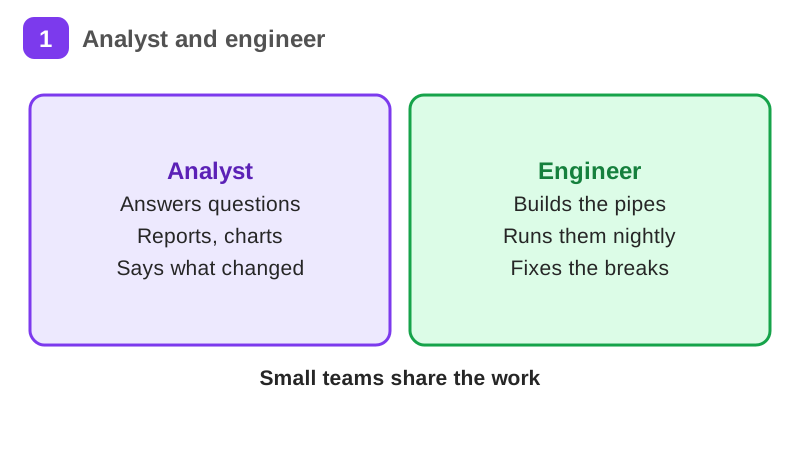
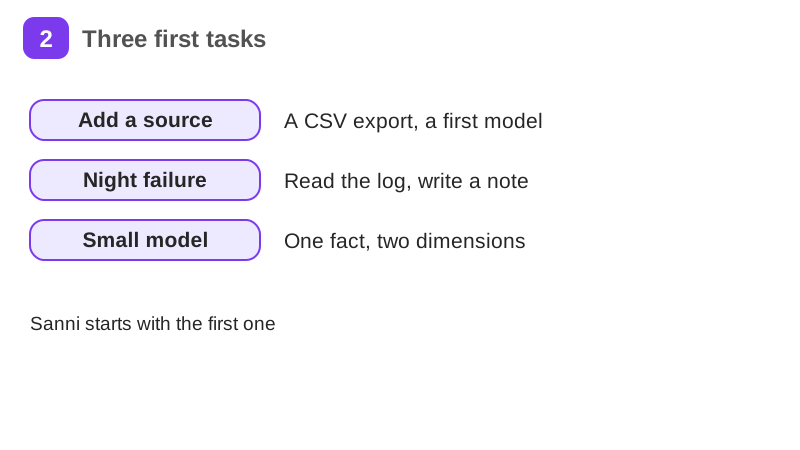
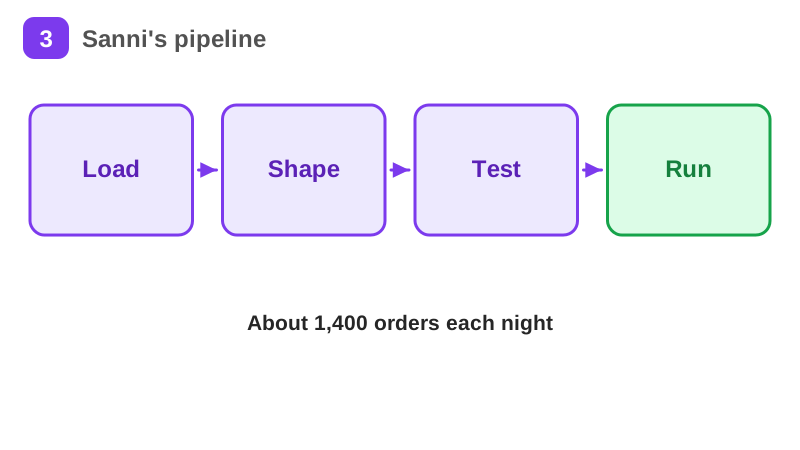
Sanni starts as the junior data engineer at Pannukahvi, a made-up online coffee shop in Helsinki. The data team has four people. On her first day the head of data gives her one job: build a small pipeline. Every night the shop's order system saves a file of orders. The report that the managers read at eight in the morning must show yesterday's orders.
It takes about 26 min of reading, plus exercises, a short quiz and a practice task. It teaches Data Engineering, ETL and dbt. Pass the short quiz at the end to get a certificate.
What you will be able to do
- A clear picture of what a data engineer does and how it differs from a data analyst
- The ELT idea and a raw, staging and mart layout you can explain in an interview
- A way to practise for free, and a clear rule on what data you may put there
- A small pipeline plan: SQL queries, dbt data tests and a task order for a scheduler
- A reading of Finnish and Nordic job ads, and the free courses that fit them
Who it is for
Time per page: 15 to 20 minutes Whole course: about 3 hours, at your own speed This is for you if you are: - A data analyst or a developer who wants to move towards data engineering - Changing career and comfortable with a spreadsheet and a little code - Reading job ads that say "ETL/ELT", "dbt" or "Airflow" and wanting to know what they mean You do not need to have worked with a warehouse before. Some SQL helps. The SQL page shows every query it uses. ---
The situation you work through
Sanni, a made-up junior data engineer at the made-up Helsinki online coffee shop Pannukahvi, builds a small ELT pipeline that loads the nightly orders file into a warehouse, shapes it with SQL and dbt, tests it and schedules it, a step per page.
Your practice task
Build Sanni's pipeline on invented data. Make a small orders file with duplicate rows, load it into a free warehouse in a region you chose, and write a staging query that removes the duplicates and a mart query that sums revenue per day. Add data tests for the key column and one status column, and write the order of tasks a scheduler would run. Then write a short incident note for a night when one test fails. Submit the queries, the test file, the task order and the note, with the warehouse and region you used and why.
Key topics
- What a junior data engineer does
- ELT and the shape of a pipeline
- Warehouses and free practice options
- SQL transforms
- dbt and its 2026 names
- Data tests
and 4 more pages
What you get when you pass
A certificate with your name, the course and the date. Sharing it is your choice. If you share it, it has a public link that anyone can open to check it, and you can add it to LinkedIn.
Common questions about Data engineering fundamentals
- Is Data engineering fundamentals free?
- Yes. The course is free with a Herizon account, and the account is free too.
- How long does Data engineering fundamentals take?
- It takes about 26 min of reading, plus exercises, a short quiz and a practice task. You can stop and continue later, because the portal keeps your place.
- Do I get a certificate?
- Yes. Pass the short quiz at the end to get a certificate you can share, for example on LinkedIn.
- What do I need to start?
- A free Herizon account. The course is written at beginner level.
- Who can join Herizon?
- You can join if you live in the EU, EEA, UK or Switzerland, or a partner organisation invited you.
- Who is Data engineering fundamentals for?
- Time per page: 15 to 20 minutes Whole course: about 3 hours, at your own speed This is for you if you are: - A data analyst or a developer who wants to move towards data engineering - Changing career and comfortable with a spreadsheet and a little code - Reading job ads that say "ETL/ELT", "dbt" or "Airflow" and wanting to know what they mean You do not need to have worked with a warehouse before. Some SQL helps. The SQL page shows every query it uses. ---
Start Data engineering fundamentals free
Start this course freeCommon questions about Data engineering fundamentals
- Is Data engineering fundamentals free?
- Yes. The course is free with a Herizon account, and the account is free too.
- How long does Data engineering fundamentals take?
- It takes about 26 min of reading, plus exercises, a short quiz and a practice task. You can stop and continue later, because the portal keeps your place.
- Do I get a certificate?
- Yes. Pass the short quiz at the end to get a certificate you can share, for example on LinkedIn.
- What do I need to start?
- A free Herizon account. The course is written at beginner level.
- Who can join Herizon?
- You can join if you live in the EU, EEA, UK or Switzerland, or a partner organisation invited you.
- Who is Data engineering fundamentals for?
- Time per page: 15 to 20 minutes Whole course: about 3 hours, at your own speed This is for you if you are: - A data analyst or a developer who wants to move towards data engineering - Changing career and comfortable with a spreadsheet and a little code - Reading job ads that say "ETL/ELT", "dbt" or "Airflow" and wanting to know what they mean You do not need to have worked with a warehouse before. Some SQL helps. The SQL page shows every query it uses. ---
More in Data analyst
- Data analytics fundamentals41 min · 11 pages
- Excel for office and data jobs30 min · 12 pages
- SQL & data analysis49 min · 10 pages
- Python for beginners53 min · 11 pages
- Desk research that actually informs decisions28 min · 11 pages
- Machine learning fundamentals36 min · 11 pages
- Power BI basics for data roles27 min · 12 pages
- Data science fundamentals29 min · 10 pages