
API fundamentals
API fundamentals is a free, beginner online course from Herizon.
Understand how APIs work, how to use them, and how to build simple ones. REST, JSON, authentication, and practical examples.
You finish with REST APIs and HTTP added to your Herizon profile.
Free · 49 min read · certificate when you pass the quiz · part of Technical founder · last updated 9 November 2026
Free account, about two minutes. You can join if you live in the EU, EEA, UK or Switzerland, or a partner organisation invited you.
Already have an account? Open it in the portalA look inside the course
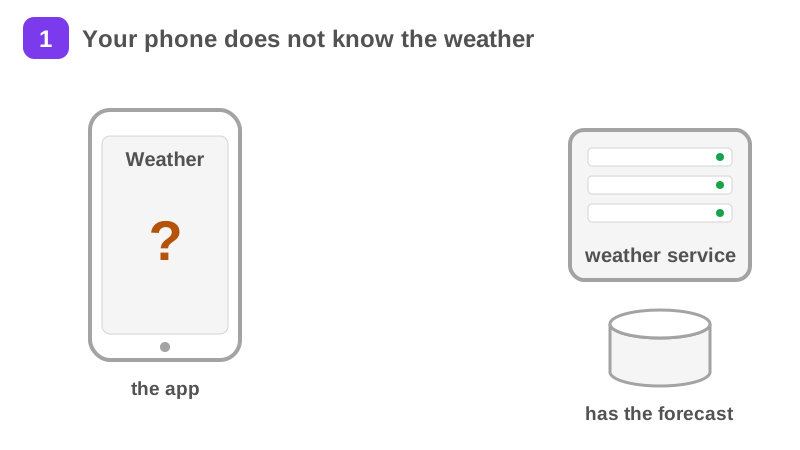
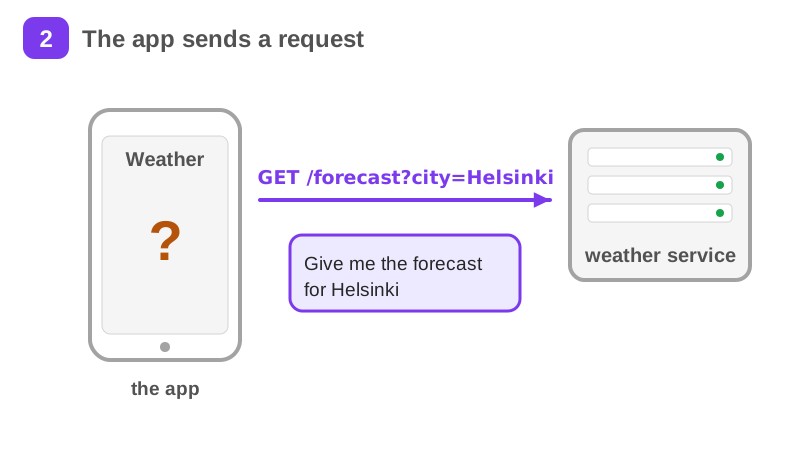
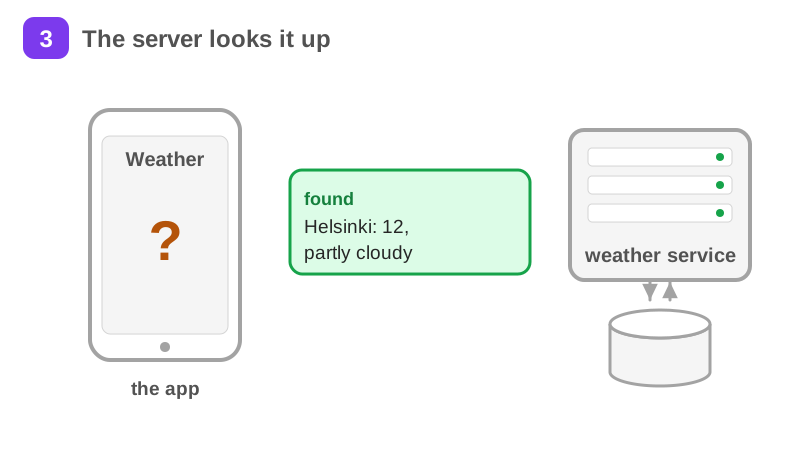
Elias is a junior developer at Tuulia Apps, a small studio in Helsinki (a worked example, not a real company). His first task is a forecast card for the studio's app. Across this course he builds that card, reads the studio's user list, writes a small to-do API and learns the limits of other people's APIs. This page starts with one question: where does a number like "12 degrees" come from?
It takes about 49 min of reading, plus exercises, a short quiz and a practice task. It teaches REST APIs and HTTP. Pass the short quiz at the end to get a certificate.
What you will be able to do
- What APIs are and why they matter in today's software
- How HTTP methods (GET, POST, PUT, DELETE) work and what status codes mean
- How JSON works and why it's the standard data format for APIs
- How to make API requests with tools like curl and Postman
- How API authentication works, including API keys and OAuth basics
- How to read and find your way around API docs
- How to build a simple API endpoint from scratch
- How to handle errors well in API requests and responses
- How rate limiting (429 and Retry-After) and pagination work and why they exist
- How real APIs like Stripe, GitHub, and weather services are built
- How to put it all together in an API package of your own
Who it is for
Developers, people who want to become developers, or anyone who works with software. It's for you if you want to know how different systems talk to each other. Maybe you're building a frontend that needs data from a backend. Maybe you're connecting a third-party service. Or maybe you're just curious how apps work on the inside. You don't need any API experience. You should know what a web browser does. You should also be at ease with simple coding ideas like variables and functions.
The situation you work through
Elias, a junior developer at Tuulia Apps, a small studio in Helsinki, builds a forecast card that shows 12 degrees from a weather API, reads and creates the user cards 42 and 43, writes a to-do API, then fetches a list of 250 users in pages of 25 without passing a limit of 60 requests a minute.
Your practice task
Build an API package for a free public API you pick. Read its docs and send one request, then run the docs example as it is and change one thing. Build a small API of your own with four endpoints (list, one by id, create, delete) that answers 404 for a missing id and 400 for a missing field, and test it with curl. Write an error plan for the three places a request can fail, and a limits plan with a rule for a 429 and a loop that fetches every page. Submit it as one page without any keys.
Key topics
- What is an API
- HTTP methods and status codes
- JSON and data formats
- Making API requests
- Authentication
- Reading API documentation
and 5 more pages
What you get when you pass
A certificate with your name, the course and the date. Sharing it is your choice. If you share it, it has a public link that anyone can open to check it, and you can add it to LinkedIn.
Common questions about API fundamentals
- Is API fundamentals free?
- Yes. The course is free with a Herizon account, and the account is free too.
- How long does API fundamentals take?
- It takes about 49 min of reading, plus exercises, a short quiz and a practice task. You can stop and continue later, because the portal keeps your place.
- Do I get a certificate?
- Yes. Pass the short quiz at the end to get a certificate you can share, for example on LinkedIn.
- What do I need to start?
- A free Herizon account. The course is written at beginner level.
- Who can join Herizon?
- You can join if you live in the EU, EEA, UK or Switzerland, or a partner organisation invited you.
- Who is API fundamentals for?
- Developers, people who want to become developers, or anyone who works with software. It's for you if you want to know how different systems talk to each other. Maybe you're building a frontend that needs data from a backend. Maybe you're connecting a third-party service. Or maybe you're just curious how apps work on the inside. You don't need any API experience. You should know what a web browser does. You should also be at ease with simple coding ideas like variables and functions.
Start API fundamentals free
Start this course freeCommon questions about API fundamentals
- Is API fundamentals free?
- Yes. The course is free with a Herizon account, and the account is free too.
- How long does API fundamentals take?
- It takes about 49 min of reading, plus exercises, a short quiz and a practice task. You can stop and continue later, because the portal keeps your place.
- Do I get a certificate?
- Yes. Pass the short quiz at the end to get a certificate you can share, for example on LinkedIn.
- What do I need to start?
- A free Herizon account. The course is written at beginner level.
- Who can join Herizon?
- You can join if you live in the EU, EEA, UK or Switzerland, or a partner organisation invited you.
- Who is API fundamentals for?
- Developers, people who want to become developers, or anyone who works with software. It's for you if you want to know how different systems talk to each other. Maybe you're building a frontend that needs data from a backend. Maybe you're connecting a third-party service. Or maybe you're just curious how apps work on the inside. You don't need any API experience. You should know what a web browser does. You should also be at ease with simple coding ideas like variables and functions.
More in Technical founder
- Vibe coding: build a small app with an AI coding tool27 min · 12 pages
- Building apps with Lovable26 min · 10 pages
- Git & GitHub for beginners38 min · 11 pages
- Getting started with Claude Code30 min · 15 pages
- Web development fundamentals50 min · 11 pages
- TypeScript fundamentals40 min · 11 pages
- AI engineering fundamentals58 min · 12 pages
- Supabase: build a backend without backend code43 min · 11 pages
- Vercel: deploy and ship fast26 min · 11 pages
- Cloud fundamentals31 min · 11 pages
- Cybersecurity fundamentals37 min · 11 pages
- Build your own bot with the Grok API36 min · 11 pages
- AI coding assistants: GitHub Copilot and OpenAI Codex22 min · 11 pages
- Take payments with Stripe29 min · 11 pages
- Cloudflare for small projects: domains, DNS and Workers25 min · 10 pages
- Build apps with v0 and Bolt37 min · 11 pages
- Java for beginners30 min · 11 pages
- Working as a junior software engineer in the Nordics27 min · 11 pages
- DevOps fundamentals: Docker, CI/CD, Kubernetes and Terraform28 min · 10 pages